Determinants of Contraceptive Implant Use: A Cross-Sectional Study at Pematang Panggang IV Community Health Center in 2025
DOI:
https://doi.org/10.52120/jlik.v3i2.133Keywords:
contraceptive implant, MKJP, age, occupation, educationAbstract
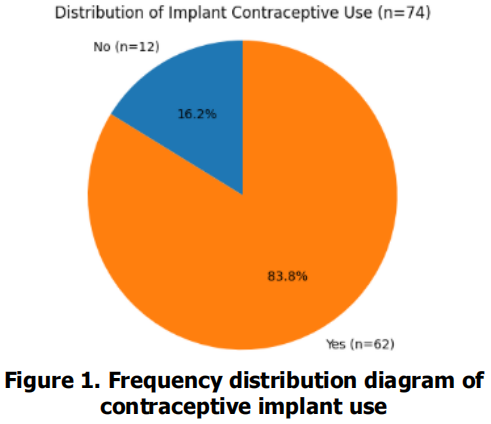
Long-Term Contraceptive Methods (LMPs), particularly implants, are effective in preventing unwanted pregnancies. However, their utilization remains relatively low compared to short-term contraceptive methods, especially at the primary health care level. Sociodemographic factors are suspected to play a role in influencing the choice of implant contraception. This study aims to analyze the relationship between age, employment status, and education level with the use of implant contraception among fertile-age couples in the Pematang Panggang IV Community Health Center, Mesuji Raya District. This study used an analytical survey design with a cross-sectional approach conducted in June 2025. The study population was all active family planning acceptors registered at the Pematang Panggang IV Community Health Center. The sampling technique used total sampling with a sample size of 74 respondents. Data were collected through structured questionnaires and medical record data. Bivariate analysis was performed using the chi-square test with odds ratio (OR) calculations and 95% confidence intervals (95% CI). The results showed that age, employment status, and education level were significantly associated with the use of implant contraception. Younger respondents were more likely to use contraceptive implants than older respondents (OR = 5.20; p = 0.009). Employed respondents were more likely to use contraceptive implants than unemployed respondents (OR = 6.27; p = 0.004). Furthermore, respondents with higher education were more likely to use contraceptive implants than respondents with lower education (OR = 1.41; p = 0.032). This study concludes that age, occupation, and education play an important role in the use of contraceptive implants, so that targeted family planning counseling and interventions are needed to increase their use in primary health care.
Downloads
References
Anggraini, M., Priyatno, A. D., & Zaman, C. A. (2024). Analisis pemilihan alat kontrasepsi implan pada wanita usia subur. Jurnal'Aisyiyah Medika, 9(2).
Anita, A. B., Aisyah, S., & Anggraini, A. (2024). Faktor Yang Berhubungan dengan Pemakaian Kontrasepsi Implan. Lentera Perawat, 5(1), 134-140.
Badan Pusat Statistik (BPS). (2024). Kota Palembang dalam angka 2024. Badan Pusat Statistik Kota Palembang.
Damayanti, R., Nisa, H., & Ariawan, I. (2019). Why don’t couples use the contraceptive that’s best for them? Social determinants of long-acting and permanent contraceptive method use in Indonesia. International Journal of Public Health Research and Development. 2019, Vol. 10, No. 2.
Faris, M. F. (2025). Strategi Adaptasi Fresh Graduate Dalam Memasuki Dunia Kerja (Studi Kasus Fresh Graduate di Kota Malang) (Doctoral dissertation, Universitas Muhammadiyah Malang).
Gayatri, M. (2020). The utilization of long-acting reversible contraception and associated factors among women in Indonesia. Global Journal of Health Science, 12(3), 110–120. https://doi.org/10.5539/gjhs.v12n3p110
https://www.academia.edu/download/71977547/43809.pdf
Handayani, S., Suraya, I., & Asiah, N. (2022). Ideation factors on long-acting reversible contraception practices among family planning clients. Jurnal Ilmiah Teknologi Kesehatan, 10(1), 1–10.
https://www.poltekkesjakarta3.ac.id/ejurnalnew/index.php/jitek/article/download/864/336
Harzif, A. K., Mariana, A., Malik, D. M., & Silvia, M. (2019). Factors associated with the utilization of long-acting reversible contraceptives among family planning clients at a rural hospital in Indonesia. F1000Research, 7, 2237.
https://pmc.ncbi.nlm.nih.gov/articles/PMC6852292/
Kementerian Kesehatan Republik Indonesia. (2021). Profil kesehatan Indonesia tahun 2020. Kementerian Kesehatan RI.
Kurniawan, D., & Pertiwi, F. D. (2021). Faktor-Faktor Yang Berhubungan Dengan Pemilihan Metode Kontrasepsi Implant Pada Wanita Usia Subur Di Kelurahan Katulampa Kota Bogor Tahun 2019. Promotor, 4(3), 199-207.
Mahendra, I. G. A. A., Wilopo, S. A., & Sukamdi. (2019). The role of decision-making pattern on the use of long-acting and permanent contraceptive methods among married women in Indonesia. The European Journal of Contraception & Reproductive Health Care, 24(6), 480–486. https://doi.org/10.1080/13625187.2019.1670345
Nurjaeni, N., Sawangdee, Y., & Pattaravanich, U. (2021). The role of structural and process quality of family planning care in modern contraceptive use in Indonesia: A multilevel analysis. BMC Public Health, 21, 1862.
https://link.springer.com/article/10.1186/s12889-021-11858-7
Sari, D. A., Noor, M. S., Suhartono, E., & Arifin, S. (2024). Meta-analysis study: Selection of long-acting contraceptive methods. Global Journal of Women’s Studies, 6(1), 1–12.
http://global-jws.com/ojs/index.php/global-jws/article/download/314/451
Setyorini, D., Lieskusumastuti, A. D., & Hanifah, N. (2022). Faktor-faktor yang memengaruhi pemilihan metode kontrasepsi jangka panjang. Jurnal Kesehatan Reproduksi, 13(2), 85–94.
Sugiana, E., Hamid, S. A., & Sari, E. P. (2021). Factors affecting contraceptive implant. J Ilm Univ Batanghari Jambi, 21(1), 372-7.
Titaley, C. R., Wijayanti, R. U., Damayanti, R., & Setiawan, A. D. (2017). Challenges to the use of long-acting and permanent methods of family planning: A qualitative study with village midwives in East Java and Nusa Tenggara Barat, Indonesia. Midwifery, 52, 121–128.
https://www.sciencedirect.com/science/article/pii/S0266613816303035
Tubagus, M., Fathurohman, A., & Aslan, A. (2023). The impact of technology on islamic pesantren education and the learning outcomes of santri: new trends and possibilities. Indonesian Journal of Education (INJOE), 2(3), 443-450.
United Nations, Department of Economic and Social Affairs, Population Division. (2019). Contraceptive use by method 2019. United Nations.
Veri, N., Lajuna, L., Alchalidi, A., & Dewita, D. (2023). The use of long-acting reversible contraceptives: A quasi-experimental study in Indonesia. British Journal of Midwifery, 31(1), 24–31. https://doi.org/10.12968/bjom.2023.31.1.24
World Health Organization. (2018). Family planning: A global handbook for providers (2018 update). World Health Organization.
Downloads
Published
Issue
Section
License
Copyright (c) 2025 Tri Oktaviani, Rini Gustina Sari, Siti Aisyah (Author)

This work is licensed under a Creative Commons Attribution-ShareAlike 4.0 International License.