Edukasi Kesehatan Berbasis Kebutuhan untuk Meningkatkan Pengetahuan Masyarakat Desa Aoma
DOI:
https://doi.org/10.52120/gxyym041Kata Kunci:
edukasi kesehatan, kesehatan ibu dan anak, literasi kesehatan, pengabdian kepada masyarakat, pre-test dan post-testAbstrak
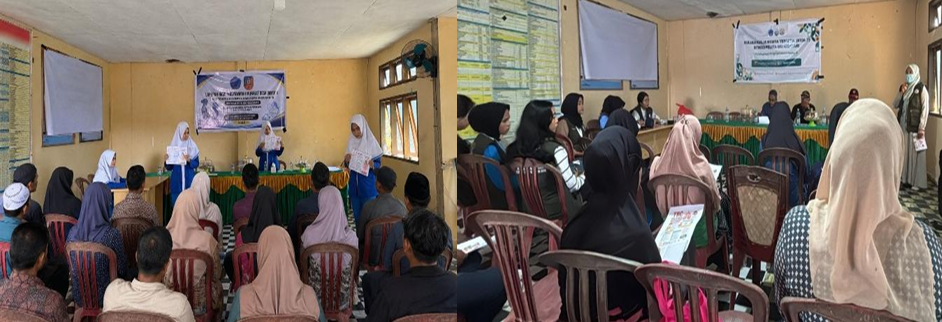
Literasi kesehatan yang belum merata dapat menghambat pengambilan keputusan dan pemanfaatan pelayanan kesehatan. Kegiatan pengabdian kepada masyarakat ini bertujuan menggambarkan perubahan pengetahuan masyarakat setelah edukasi kesehatan berbasis kebutuhan di Desa Aoma, Kecamatan Wolasi, Kabupaten Konawe Selatan. Kegiatan dilaksanakan pada 27 April-9 Mei 2026 dengan evaluasi satu kelompok pre-test dan post-test. Sebanyak 99 peserta yang menyelesaikan kedua pengukuran mengikuti edukasi interaktif mengenai HIV/AIDS dan penyakit menular seksual, ASI eksklusif, pemeriksaan Inspeksi Visual dengan Asam Asetat (IVA), Pap smear, gizi balita, dan imunisasi. Pengetahuan diukur menggunakan kuesioner yang sama sebelum dan sesudah edukasi. Data dianalisis secara deskriptif berdasarkan proporsi peserta dalam kategori pengetahuan baik dan perubahan dalam poin persentase. Proporsi pengetahuan baik meningkat pada HIV/AIDS dan PMS dari 47,47% menjadi 89,90% (+42,42 poin persentase), ASI eksklusif dari 58,59% menjadi 90,91% (+32,32), IVA dari 63,64% menjadi 88,89% (+25,25), Pap smear dari 69,70% menjadi 91,92% (+22,22), gizi balita dari 77,78% menjadi 90,91% (+13,13), dan imunisasi dari 89,90% menjadi 91,92% (+2,02). Temuan menunjukkan adanya perbaikan pengetahuan segera setelah edukasi, terutama pada topik dengan pengetahuan awal lebih rendah. Penguatan materi oleh puskesmas dan kader serta evaluasi lanjutan diperlukan untuk menilai keberlanjutan pengetahuan dan perubahan perilaku
Unduhan
Referensi
E. Lakioti, N. Pagonis, D. Flegkas, A. Itziou, K. Moustakas, and V. Karayannis, “Social Factors and Policies Promoting Good Health and Well-Being as a Sustainable Development Goal: Current Achievements and Future Pathways,” Sustainability 2025, Vol. 17, Page 5063, vol. 17, no. 11, p. 5063, May 2025, doi: 10.3390/SU17115063.
C. Benedetto et al., “FIGO Preconception Checklist: Preconception care for mother and baby,” International Journal of Gynecology and Obstetrics, vol. 165, no. 1, pp. 1–8, Apr. 2024, doi: 10.1002/IJGO.15446;
Y. Setianti, S. Dida, T. Damayanti, and C. C. Priyatna, “Public perception of health information, treatment beliefs, and disease in Indonesia: Effective health promotion strategies,” Social Sciences & Humanities Open, vol. 11, p. 101639, Jan. 2025, doi: 10.1016/J.SSAHO.2025.101639.
S. Chowdhury and A. Alzarrad, “Advancing Community-Based Education: Strategies, Challenges, and Future Directions for Scaling Impact in Higher Education,” Trends in Higher Education 2025, Vol. 4, Page 21, vol. 4, no. 2, p. 21, May 2025, doi: 10.3390/HIGHEREDU4020021.
M. Streater and A. Walton, “The role of midwives in advancing planetary health: A contemporary issue in education and practice,” Nurse Educ. Today, vol. 155, p. 106880, Dec. 2025, doi: 10.1016/J.NEDT.2025.106880.
S. Shafiah and A. I. Susanti, “Postgraduate midwifery education programs to enhance clinical competency,” Curricula: Journal of Curriculum Development, vol. 4, no. 1, pp. 749–764, Jun. 2025, doi: 10.17509/CURRICULA.V4I1.85075.
E. S. Kinyenje et al., “Quality of maternal and child health services in Tanzanian primary healthcare: a 2021–2022 star rating review,” Reproductive Health 2025 22:1, vol. 22, no. 1, pp. 180-, Oct. 2025, doi: 10.1186/S12978-025-02105-Y.
G. Maimaiti, K. F. Hew, and Y. Xiao, “Challenges to parental engagement in K-12 online learning during the pandemic: Lessons learned and a tripartite model for future involvement,” Future in Educational Research, vol. 3, no. 3, pp. 482–504, Sep. 2025, doi: 10.1002/FER3.70007.
H. Zhang and M. Saruchera, “A Critical Analysis of The HIV/AIDS Declining Trends in South Africa: What are the Issues of Concerns?,” African Journal of Human Kinetics Recreation and Health Studies, vol. 3, no. 1, pp. 27–50, Jun. 2025, doi: 10.31920/2976-7784/2025/V3N1A2.
S. Chowdhury and M. A. Haque, “Understanding the issues of women’s empowerment and fertility in Bangladesh,” Reproductive Health 2025 22:1, vol. 22, no. 1, pp. 185-, Oct. 2025, doi: 10.1186/S12978-025-02065-3.
L. Pipitò, G. D’agati, and A. Cascio, “Sexually Transmitted Infections in adolescents and young adults: a growing public health challenge,” Infez. Med., vol. 34, no. 2, p. 177, 2026, doi: 10.53854/LIIM-3402-7.
F. Abdulla, M. M. Hossain, M. Karimuzzaman, M. Ali, and A. Rahman, “Likelihood of infectious diseases due to lack of exclusive breastfeeding among infants in Bangladesh,” PLoS One, vol. 17, no. 2, p. e0263890, Feb. 2022, doi: 10.1371/JOURNAL.PONE.0263890.
A. Maleki, B. Ahadinezhad, A. Alizadeh, and O. Khosravizadeh, “Barriers and facilitators of pap-smear test uptake in Asia: a systematic review,” BMC Public Health 2025 25:1, vol. 25, no. 1, pp. 1961-, May 2025, doi: 10.1186/S12889-025-22876-0.
S. T. O’Leary et al., “Recommendations for Prevention and Control of Influenza in Children, 2025–2026: Technical Report,” Pediatrics, vol. 156, no. 6, Dec. 2025, doi: 10.1542/PEDS.2025-073622/202846.
Z. Al Kindi, W. Al Jabri, M. Al Zadjali, and J. Muliira, “Utilizing simulation in community health nursing education: a scoping review of current trends and applications,” BMC Nursing 2025 24:1, vol. 24, no. 1, pp. 1055-, Aug. 2025, doi: 10.1186/S12912-025-03718-1.
H. Leggett, M. Kitamura, A. Suppasri, F. Imamura, and T. Rossetto, “Understanding community attitudes and responses to tsunami mitigation infrastructure and DRR methods in Kesennuma, Japan,” International Journal of Disaster Risk Reduction, vol. 130, p. 105870, Nov. 2025, doi: 10.1016/J.IJDRR.2025.105870.
H. Johar et al., “Community-based heat adaptation interventions for improving heat literacy, behaviours, and health outcomes: a systematic review,” Lancet Planet. Health, vol. 9, no. 7, Jul. 2025, doi: 10.1016/S2542-5196(25)00007-5.
A. Masini, N. Cherasco, A. Conti, I. Pighini, F. Barone-Adesi, and M. Panella, “Preventive Pathways for Healthy Ageing: A Systematic Literature Review,” Geriatrics (Switzerland), vol. 10, no. 1, p. 31, Feb. 2025, doi: 10.3390/GERIATRICS10010031/S1.
P. Harris, E. McInnes, A. Farndale, G. Aghayeva, L. Depares, and P. Evans, “Dialogically Constructing a Culturally Sustaining Multilingual Family Literacies Approach in Early Childhood Settings,” Social Sciences 2025, Vol. 14, Page 144, vol. 14, no. 3, p. 144, Feb. 2025, doi: 10.3390/SOCSCI14030144.
A. A. Qomariyah and F. S. Anggraini, “Implementation of Islamic Religious Education Learning in the Independent Curriculum Using the Jigsaw Method to Enhance Student Activeness at SMAN 1 Kutorejo,” AL GHAZALI: Jurnal Pendidikan dan Pemikiran Islam, vol. 5, no. 2, pp. 319–339, Oct. 2025, doi: 10.69900/AG.V5I2.482.
J. P. C. Dukuzumuremyi, K. Acheampong, J. Abesig, and J. Luo, “Knowledge, attitude, and practice of exclusive breastfeeding among mothers in East Africa: A systematic review,” Int. Breastfeed. J., vol. 15, no. 1, pp. 70-, Aug. 2020, doi: 10.1186/S13006-020-00313-9/TABLES/5.
S. L. Belfrage, M. Husted, S. D. S. Fraser, S. Patel, and J. A. Faulkner, “A systematic review of the effectiveness of community-based interventions aimed at improving health literacy of parents/carers of children,” Perspectives in Public Health, vol. 145, no. 1, 2025, doi: 10.1177/17579139231180746.
L. Pipitò, G. D’Agati, and A. Cascio, “Sexually transmitted infections in adolescents and young adults: A growing public health challenge,” Infezioni in Medicina, vol. 34, no. 2, p. 177, 2026, doi: 10.53854/liim-3402-7.
A. D. Anggraeni and A. H. Kusuma, “Pengaruh media edukasi ‘Imunisasi-Q’ terhadap pengetahuan kader posyandu dalam memotivasi orang tua pada anak usia 0-9 bulan,” Jurnal Ilmu Kesehatan Bhakti Husada, vol. 13, no. 1, pp. 10-16, 2022, doi: 10.34305/jikbh.v13i1.438.
N. Yusnia, K. Khoirunnisa, M. Rachmani, M. Maulida, and N. Khofia, “Edukasi pentingnya kesadaran ibu terhadap imunisasi pada bayi sejak dini,” Jurnal Pemberdayaan dan Pendidikan Kesehatan, vol. 4, no. 1, pp. 14-21, 2024, doi: 10.34305/jppk.v4i01.1308.
Unduhan
Diterbitkan
Terbitan
Bagian
Lisensi
Hak Cipta (c) 2026 Ririt Yuliarti Taha, Juli Purnama Hamudi, Ano Luthfa, Dian Rosmala Lestari, Via Zakiah, Harni (Author)

Artikel ini berlisensi Creative Commons Attribution 4.0 International License.