
Peer Review Process
The Editor-in-Chief assigns the manuscript to the Managing Editor for further processing. The Managing Editor requests at least two scientists to review the research manuscript. All manuscripts undergo a double-blind peer review process—where the identities of the reviewers and authors are kept confidential from one another—to ensure standards of academic excellence are met.
Detailed information regarding the workflow from manuscript submission (by the author) to acceptance by the editor is illustrated in the following figure.
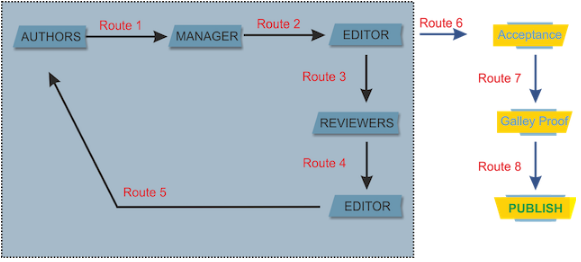
In summary, the steps are as follows:
- Manuscript Submission (by the author) (Path 1)
- Manuscript Screening and Selection (by the manager and editor) (Path 2). The editor has the authority to accept, reject, or send the manuscript for review immediately. Prior to further processing, a plagiarism check using Turnitin is conducted for every manuscript.
- Manuscript Review Process (by reviewers) (Paths 3–4)
- Notification of Acceptance, Revision, or Rejection (sent by the editor to the author based on reviewer comments) (Path 5)
- Paper Revision (by the author)
- Submission of Revisions based on Reviewer Suggestions (by the author), following the same procedure as step 1 (Path 1)
- If the reviewer is satisfied with the revisions, notification of acceptance is issued (by the editor) (Path 6)
- Proofing and galley publication process (Paths 7 and 8)
Steps 1 through 5 constitute a single round of the peer-review process (see the shaded area in the figure). The editor or editorial board considers the feedback provided by peer reviewers and makes a decision. The most common decisions are as follows:
- Accepted as is: The journal will publish the paper in its original form;
- Accepted with minor revisions: The journal will publish the paper but requires the author to make minor corrections (allowing the author a specified timeframe for revisions);
- Accepted with major revisions: The journal will publish the paper provided the author makes the changes suggested by the reviewers and/or editor (allowing the author a specified timeframe for revisions);
- Resubmit (conditional rejection): The journal is willing to reconsider the paper in a subsequent decision-making round after the author makes major changes;
- Rejected (outright rejection): The journal will not publish the paper or reconsider it, even if the author makes major revisions.


